In the first two chapters of this story we did the unglamorous work. We read our first pilot’s own analytics, and we told the truth about what we found. Large language models were already recommending the pilot for high-intent category questions, but the mention lift was mostly branded. The non-branded category rate was 0 of 24 sampled answers[5]. That is a real gap, and a gap is only useful if you have a plan you can defend.
This is the chapter about the plan.
How does Ignite turn a baseline into an action plan you can approve?
Ignite turns a measured baseline, meaning what AI assistants currently say about a brand, into a page-level action plan, a queue of specific changes a site owner reads and approves one at a time. For our first pilot the pipeline built a 67-item page-level plan from the crawl page-signals and the tenant’s goals, not from the live sweep results, and we verified the full flow running end to end on the live tenant[6]. Separately, the live sweeps track 95 claims for that same tenant. That is our own measurement on one tenant at one point in time, not a general benchmark. Nobody signs a blank check. Every item earns its place on the list, or it comes off.
The discipline is simple. If a lever is on that list, it traces to published research, not to folklore. Here is how the real ones survive that test.
Why should the canonical fact lead the page?
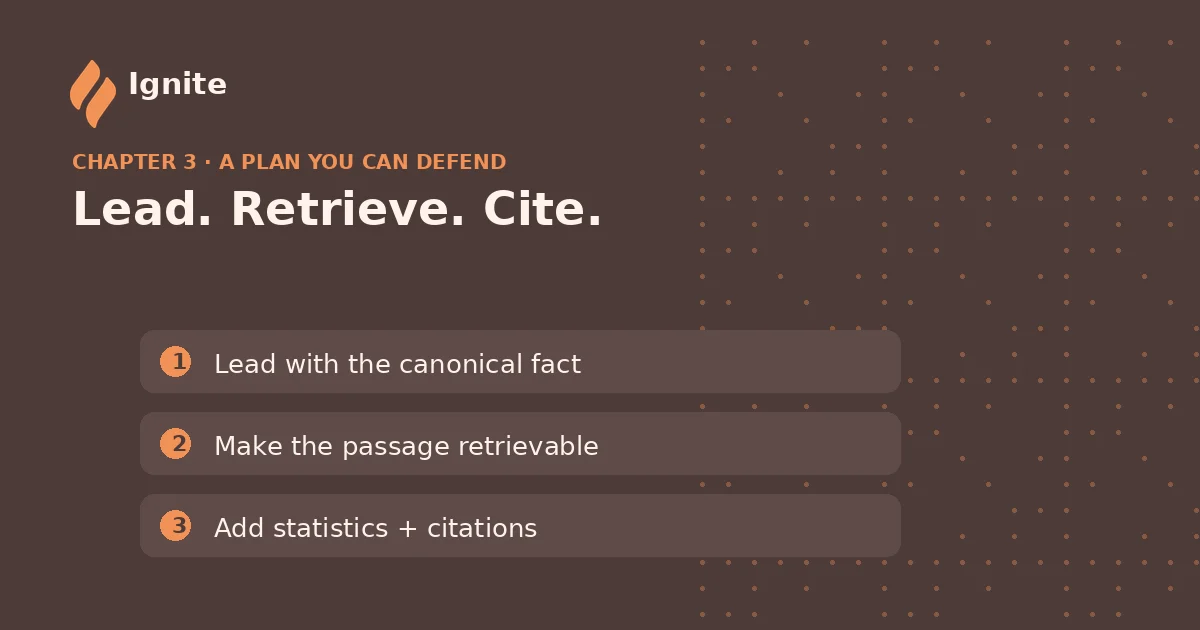
The canonical fact leads the page because language models use information best when it sits at the start or end of the context, and worst when it is buried in the middle. Liu et al. documented that U-shaped positional-use curve in Lost in the Middle (TACL 2024)[1]. So we front-load the one sentence that defines the entity and keep pages tight. The primacy position survives truncation and lands where the model actually pays attention.
How do you make a passage retrievable in the first place?
You make a passage retrievable by writing it as a self-contained, entity-first block a retriever can match to a query. Retrievers score a passage by how closely its embedding matches the query, then return the top results (Karpukhin et al., Dense Passage Retrieval, EMNLP 2020)[2]. Structure reinforces this. Shaukat et al. (chunking study, 2026)[3] found structure-aware, paragraph-level chunks reached roughly 24% precision-at-1 against 2 to 3% for arbitrary character splits, and the effect held across multiple embedding models. That 24% is a RAG-pipeline lab result and only indirect evidence about any specific frontier engine, so we never quote it to a customer as their own expected number. It shows the practice is sound and model-agnostic to first order, not a promise about a specific site.
What is the one GEO lever proven on a live engine?
The one GEO (generative engine optimization) lever proven on a live engine is adding statistics, citations, and quotations to the visible content. Aggarwal et al. (GEO: Generative Engine Optimization, KDD 2024)[4] measured that this lifted answer visibility by 30 to 40% on their benchmark and by 22% Position-Adjusted Word Count. The scope rides with the number every time. Visibility there means Position-Adjusted Word Count, how much of your own text the answer quotes back, not traffic, not ranking, not sales, not brand awareness. We hand customers the practice, not someone else’s percentage, and we never present that lift as a result a reader or a pilot will get.
What is not a GEO lever?
Structured data, FAQ blocks, and llms.txt are not GEO (generative engine optimization) levers. We validated that AI crawlers could reach our first pilot’s live site, and in the same step we dropped llms.txt as a non-lever[7]. We do not sell schema markup or FAQ blocks as a citation or retrieval lever either. Google has removed FAQ rich results, and JSON-LD helps a search engine parse a page without being what makes an AI cite a brand. When a technique does little on its own, honesty means saying so and leaving it off the list.
What can our first pilot’s data prove, and what can it not?
Our first pilot’s data proves the plan runs and the measurement is real, not that the pilot has won its category. We connected the pilot’s analytics, GA4 and Search Console, and the platform surfaced 3 AI Assistant sessions against 713 Direct sessions, then flagged that AI-referral counts are undercounted, with an estimated floor of 35 to 70%[8]. Over a 21-day window the pilot accumulated 1,658 AI answer samples across live sweeps[9]. Both figures are single-tenant and point-in-time, not a benchmark anyone should expect.
We are not claiming the pilot has won its category. We are telling you the plan is built, it runs, and every line on it can be defended. Results are earned, not asserted. That is the whole point of the list.
References
- [1] Liu et al., Lost in the Middle: How Language Models Use Long Contexts, TACL 2024 https://arxiv.org/abs/2307.03172: a U-shaped positional-use curve, models use information best at the start or end of the context and worst when it is buried in the middle. Qualitative, so we attach no headline percentage. Basis for leading with the canonical fact.
- [2] Karpukhin et al., Dense Passage Retrieval for Open-Domain Question Answering, EMNLP 2020 https://arxiv.org/abs/2004.04906: a passage is scored by the embedding similarity between query and passage, and the top-k are returned. The reason a self-contained, entity-first passage is more retrievable.
- [3] Shaukat et al., Chunking Strategies, 2026 https://arxiv.org/abs/2603.06976: structure-aware paragraph chunks reached precision-at-1 of roughly 24% versus 2 to 3% for arbitrary character splits, held across multiple embedding models. Scope: a RAG-pipeline lab result and indirect evidence about any specific frontier engine, never a customer’s own expected number.
- [4] Aggarwal et al., GEO: Generative Engine Optimization, KDD 2024 https://arxiv.org/abs/2311.09735: adding statistics, citations, and quotations to visible content lifted answer visibility by 30 to 40% on the GEO benchmark and 22% Position-Adjusted Word Count. Scope: visibility is Position-Adjusted Word Count, how much of your own text the answer quotes back, not traffic, ranking, sales, or brand awareness, and never a result a reader or a pilot will get.
- [5] Our first pilot, baseline measurement: the non-branded category mention rate was 0 of 24 sampled answers. Single-tenant and point-in-time, not a benchmark anyone should expect.
- [6] Our first pilot, measurement: a 67-item page-level action plan built from crawl page-signals and the tenant’s goals, not from the live sweep results; separately, the live sweeps track 95 claims for that same tenant. Full flow verified running end to end on one live tenant. Our own measurement on a single tenant at a single point in time, not a general benchmark.
- [7] Our first pilot, configuration finding: AI-crawler access to the live pilot site validated, and llms.txt dropped as a non-lever. A first-party finding on one site, not a general rule about crawler behavior.
- [8] Our first pilot, measured data: GA4 and Search Console connected, showing 3 AI Assistant sessions against 713 Direct sessions, with AI-referral counts flagged as undercounted (estimated 35 to 70% floor). A single point-in-time read, not a lift attributed to our work.
- [9] Our first pilot, measurement: 1,658 AI answer samples accumulated over a 21-day window across live sweeps. Single-tenant and point-in-time, not a trend anyone should generalize.